


The branding method you choose determines how a custom sock looks on day one and how it looks after fifty washes — and those are often two very different answers. This guide compares printing, embroidery, and knit-in construction directly, so the decision comes down to what your design and program actually need, not which method a supplier happens to push hardest.
Three Methods, Not Two: Printing, Embroidery, and Knit-In
The question "printing vs embroidery" leaves out the method most premium sock suppliers actually recommend first: knit-in (jacquard) construction, where the design is woven directly into the fabric during manufacturing rather than applied afterward. Solos offers printed, embroidered, and knit-in branding across its range, and its own quality comparison guide is direct about the trade-off: printed branding sits on the surface of the sock and will eventually crack, peel, or fade, often within months, while knit-in branding is woven into the fabric itself and holds up for the life of the sock.
That doesn't mean printing or embroidery are wrong choices — each has genuine strengths for specific designs and budgets. It means the decision needs all three options on the table, not just two.
Why This Question Comes Up So Often
Most people researching "printing vs embroidery" for socks are really asking a proxy question: how do I make sure this order looks as good in six months as it does on delivery day, without overpaying for a durability level I don't actually need? A one-off conference giveaway and a five-year corporate uniform program have completely different answers to that question, even if the logo file is identical. The method comparison only makes sense once you know which of those two situations you're actually in.
Head-to-Head Comparison
| Method | Best For | Durability | Colour/Detail Capability |
|---|---|---|---|
| Printing (sublimation / heat transfer) | Full-colour, photographic, or gradient artwork | Lower — surface application can crack, peel, or fade with repeated washing | Highest — near-unlimited colour and fine detail |
| Embroidery | Small, simple logos wanting a premium tactile finish | High for the stitched area, though thread can loosen at heavy-flex zones over time | Limited — bold shapes and text only, not gradients or fine detail |
| Knit-in (jacquard) | Logos, colour blocks, and patterns needing long-term durability | Highest — woven into the fabric, holds for the life of the sock | Moderate — limited by yarn colour combinations, typically 3-6 colours |
When Printing Is the Right Call
Printing (sublimation or heat transfer) earns its place for a specific kind of design brief: full-colour, photographic, or gradient artwork that simply can't be reproduced any other way. If your design includes a photo, a complex multi-tone illustration, or a gradient fade, printing is often the only method that will actually reproduce it accurately.
- Strengths: near-unlimited colour range, fine detail reproduction, generally the fastest turnaround of the three methods, and often accommodates lower minimums than knit-in
- Trade-offs: surface-applied designs are more prone to cracking, peeling, or fading with repeated washing, and they generally sit on top of the fabric rather than integrating with its texture
- Best suited to: one-off event merchandise, gifting programs where longevity matters less than day-one visual impact, and any design with genuine photographic or gradient content
It's worth understanding why printed designs fade rather than just accepting it as a given: heat transfer and sublimation both apply colour to the surface or near-surface of the fabric, rather than dyeing the yarn itself before knitting. Every wash cycle introduces friction and, depending on detergent, some chemical exposure — both of which gradually break down that surface layer. This isn't a manufacturing defect; it's an inherent trade-off of how the method works, which is exactly why it suits short-lifespan use cases better than long-term programs.
When Embroidery Is the Right Call
Embroidery occupies a middle ground — a raised, tactile finish that reads as premium, well suited to smaller, simpler logos rather than full-sock designs.
- Strengths: a textured, dimensional finish that feels premium to the touch, strong durability for the stitched area itself, and a classic look that works well for corporate and golf-style branding
- Trade-offs: limited to bold, simple shapes — fine text, thin lines, and gradients don't translate well to stitching, and it's generally not suited to full-coverage or all-over designs
- Best suited to: small logo placements, corporate gifting where a premium tactile feel matters, and designs that are already simple and clean rather than detail-heavy
Placement Matters More for Embroidery Than People Expect
Because embroidery adds a raised, stitched layer to the fabric, where it sits on the sock affects both comfort and durability more than with a flat printed or knit-in design. A logo embroidered directly over a high-flex zone — the top of the foot during a deep bend, for example — can feel different underfoot than the surrounding fabric, and repeated flexing at that exact point is also where stitching is most likely to loosen over time. Placing embroidery on the upper calf, away from flex-heavy zones, generally holds up better and feels more comfortable than a placement chosen purely for visual balance.
When Knit-In Is the Right Call
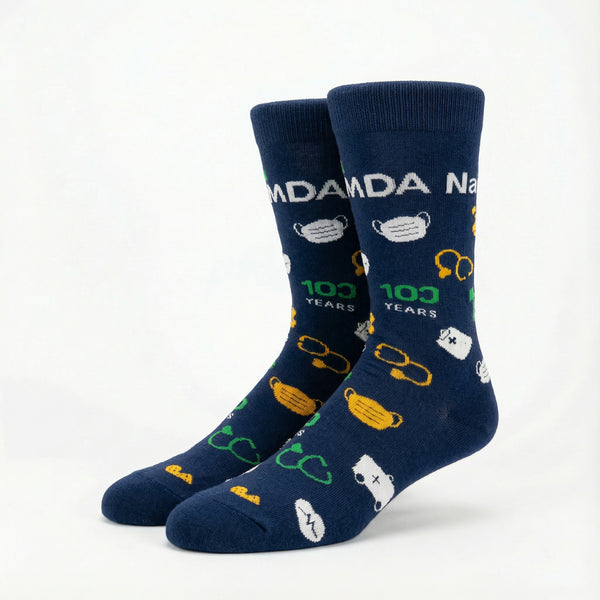
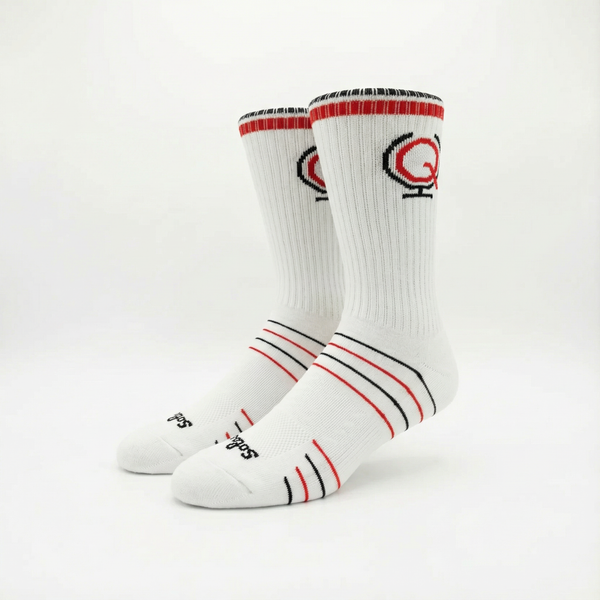
Knit-in (jacquard) construction weaves the design directly into the fabric during manufacturing, using the same knitting process that builds the sock itself. Per Solos' own quality comparison guide: "If a supplier can't confirm jacquard knit, assume it's print" — a useful line to remember when evaluating a supplier's claims.
- Strengths: the most durable option by a clear margin — the design won't crack, peel, or fade because it's structurally part of the fabric, not applied to its surface. This is the same construction covered in our team-sport guides for baseball, football and soccer, and hockey programs specifically because it survives a full season of wash cycles
- Trade-offs: colour range is limited by yarn combinations (typically 3-6 colours), fine detail and photographic content don't translate well, and setup typically requires a higher minimum order than printing
- Best suited to: ongoing corporate, team, and wholesale programs where the sock needs to look good after months of regular wear, not just on delivery day
Worth noting: knit-in is also the construction method behind performance features like Solos' NeuWave™ arch compression — the branding and the structural technology are built in the same knitting pass, which isn't possible with printing or embroidery applied afterward.
How Your Design Should Actually Drive the Decision
Rather than choosing a method first and forcing the design to fit, work backwards from what the artwork actually requires:
- Does the design include a photo, gradient, or more than 6 colours? Printing is likely your only option.
- Is it a small, simple logo where a premium tactile feel matters more than full-coverage design? Embroidery is worth considering.
- Is this a recurring program where the sock needs to look good after months of wear? Knit-in is the durability-first choice, even if it means simplifying the design to fit yarn colour limits.
- Is budget or minimum order quantity the primary constraint? Printing generally accommodates lower minimums than knit-in — worth weighing against our wholesale MOQ and pricing guide if volume is the deciding factor.
A design built for one method rarely translates cleanly to another — simplifying a photographic logo down to a 3-colour knit-in version, for example, is a real design exercise, not a quick file conversion. Deciding on method early, before artwork is finalised, saves a redesign cycle later.
What to Ask a Supplier Before Committing
- Which method do you recommend for this specific design, and why? A supplier that recommends the same method for every design regardless of artwork complexity may be steering you toward whatever's cheapest for them to produce, not what's best for your design.
- Can I see a physical sample in the proposed method, not just a digital mockup — this matters more for printing and embroidery, where the physical texture and finish genuinely affect the outcome
- How does durability compare across wash cycles for this specific method? As covered in our quality comparison guide, this is one of the clearest signals of overall supplier quality
- Does the MOQ differ by method? Printing, embroidery, and knit-in often carry different minimums even from the same supplier
Frequently Asked Questions
Is embroidery more durable than printing on socks?
Generally yes for the stitched area itself, though embroidery thread can loosen over time at high-flex points on the sock. Neither embroidery nor printing matches the durability of knit-in (jacquard) construction, where the design is woven into the fabric rather than applied to its surface.
Can printing reproduce a photo or gradient design on socks?
Yes — sublimation and heat transfer printing are generally the only methods that can accurately reproduce photographic detail or colour gradients. Knit-in and embroidery are both limited to simpler shapes and a smaller colour palette.
Why does Solos recommend knit-in branding over printing?
Because the design is woven into the fabric during manufacturing rather than applied to the surface afterward, knit-in branding doesn't crack, peel, or fade the way printed branding can with repeated washing — a durability difference that matters most for ongoing corporate, team, and wholesale programs rather than one-off event merchandise.
Does the minimum order quantity change depending on branding method?
Often, yes. Printing generally accommodates lower minimums than knit-in construction, since it doesn't require programming a dedicated knitting pattern. Confirm the current MOQ for your specific method and design directly, since this can vary by product line as well as method.
Can I combine methods on the same sock — for example, a knit-in logo with a printed detail?
Some suppliers can combine methods for complex designs, though it typically adds cost and production time compared to a single-method design. Ask directly whether this is something your supplier's production process supports before finalising artwork that assumes it.
How do I convert a photographic or gradient logo to work with knit-in construction?
This usually means simplifying the design down to solid colour blocks and clean shapes that fit within the yarn colour limit (typically 3-6 colours for jacquard knit). It's a genuine design exercise rather than an automatic file conversion — a designer familiar with knit-in constraints can usually adapt a logo, but it's worth planning for this step early rather than discovering it's needed after artwork approval is already underway.
Not sure which method fits your design?
Free artwork mockup within 12 hours — share your design and get a direct recommendation on printing, embroidery, or knit-in before you commit.
Request Free Mockup →
