


A football or soccer club's socks do more work than any other kit item — they need to fit over shin guards, hold team colours through a full season of wash cycles, and often carry roster numbers on top of the club crest. This guide covers what club kit managers, coaches, and league coordinators actually need to know before placing a bulk sock order, and where general "athletic sock" sourcing advice doesn't quite fit a football-specific order.
- Who's ordering custom football and soccer socks
- Fit over shin guards: the construction question most guides skip
- Matching club colours across a full squad
- Numbers, crests, and roster-level kit personalisation
- Materials for a full season on the pitch
- Timing your order around the season calendar
- What to check before ordering club kit
- Frequently asked questions
Who's Ordering Custom Football and Soccer Socks
"Custom football socks" and "custom soccer socks" searches split fairly cleanly into a few buyer types, each closer to the general team-kit and wholesale patterns covered in our team ordering guide and wholesale MOQ and pricing guide than most sport-specific content assumes:
- Club and academy kit managers — ordering for a full playing squad, usually against a pre-season deadline, often across multiple age-group teams within one club
- League administrators — standardising a base sock design across multiple clubs within a league, sometimes with club-specific colourways layered on a shared template
- School and college athletics departments — ordering alongside jerseys and shorts as part of a full kit program, frequently on a tighter combined budget than a standalone sock order
- Supporter and merchandise buyers — smaller retail-style orders in club colours, distinct from the on-field playing kit itself
Club and league kit managers are the highest-stakes segment here — a kit order that doesn't fit correctly or match colours precisely is a visible, public problem in a way a corporate gifting mismatch usually isn't.
It's also worth separating playing kit from merchandise early in the planning process, since they're often sourced differently even within the same club. Playing kit needs to meet functional and sometimes league-compliance requirements (fit over shin guards, approved sponsor placement); supporter merchandise in club colours has far more design flexibility but usually a lower per-unit budget. Treating both as one undifferentiated "club socks" order tends to produce a compromise that serves neither well.
Fit Over Shin Guards: The Construction Question Most Guides Skip
Football and soccer socks have one structural requirement that sets them apart from most other team sportswear: they need to sit correctly over a shin guard without bunching, slipping, or restricting movement. This is a fit and length question as much as a material one.
| Length | Description | Typical Use |
|---|---|---|
| Crew | Ankle-to-mid-calf, standard athletic length | Training sessions, warm-up wear, casual club merchandise |
| Over-the-calf / knee-high | Extends above the knee, covers the full shin guard | Match-day playing kit — the standard expected length for competitive football and soccer |
Worth confirming directly: the tall, over-the-calf sock that fits over a shin guard is a specific construction, and not every supplier's general "athletic sock" range is built to that length. Solos' published Custom Branded Athletic Socks line uses NeuWave™ arch compression in a standard athletic construction; the closest published reference for a taller, over-the-calf profile on Solos' site is the equestrian sock line. If your club specifically needs a true knee-high, shin-guard-covering match sock, confirm that exact length and fit is available before ordering, the same way our baseball and softball team guide recommends confirming stirrup construction before assuming a general athletic range covers it.
Matching Club Colours Across a Full Squad
Club colours are usually more precisely defined than a typical corporate brand palette — many clubs have exact Pantone references tied to crest, kit sponsor agreements, or league branding rules. A few things reduce colour-mismatch risk on a squad order:
- Supply the club's actual Pantone (PMS) codes, not a colour name or a photo of an old kit — this is the same principle covered in more general terms in our wholesale pricing and ordering guide, but matters even more for a visible on-field kit item
- Order the full squad in one production batch rather than splitting the order, since colour can vary slightly between separate dye lots
- Request a physical proof before the full run — screen colour and knitted-yarn colour don't always match exactly, particularly for kit sponsor colours that sit close to a competitor's
Knit-in (jacquard) construction, where the design is woven directly into the fabric rather than printed on top, holds colour more consistently across a season of match-day washing than a printed alternative — the same durability point our quality comparison guide covers for custom socks generally.
Numbers, Crests, and Roster-Level Kit Personalisation
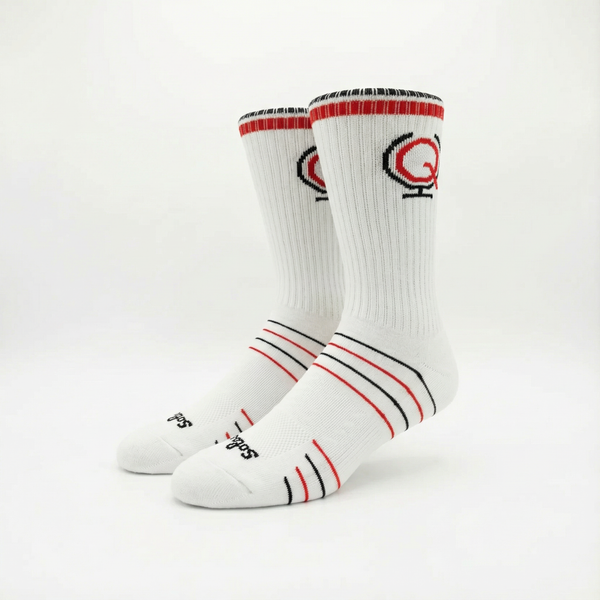
A club sock order typically layers individual variation onto a shared base design — squad numbers, sometimes player initials, occasionally captain markers — the same roster-personalisation pattern our personalised socks guide covers for team buyers generally. For football and soccer specifically, worth confirming directly:
- Whether squad numbers can be added to individual pairs without re-running the full design process per player
- How mid-season squad changes (new signings, number changes) are handled for top-up orders
- Whether the crest and any sponsor logo placement is confirmed compliant with league branding rules before production, since some competitions have specific kit-branding restrictions
Submitting a single squad list (name, number, size) alongside the base design approval — rather than iterating over email — keeps a roster order on the standard production timeline rather than triggering a slower, personalisation-specific run.
League Branding Rules Are Worth Checking Early
Many competitive leagues, especially at school, college, and semi-professional level, have specific rules about sponsor logo size, placement, and even how many colours can appear on a match sock. This is easy to overlook when the focus is on getting the club's own crest and colours right, but a kit that technically breaches a league's branding rules can mean a delayed approval or a reprint right before a season starts. Confirm your league's current kit regulations before finalising artwork, not after production has already started — a supplier can produce exactly what you approve, but they generally won't know your league's specific compliance rules unless you tell them.
Materials for a Full Season on the Pitch
Match and training socks face a specific combination of stress: repeated sliding tackles, studded boot pressure at the ankle, and a heavy wash schedule across a season. Material choice matters more here than branding method:
- Organic cotton or bamboo blends — comfortable for training wear, naturally antibacterial, but generally less abrasion-resistant than technical blends under repeated tackling and sliding
- Technical blends with reinforced heel, toe, and shin panel — better suited to match-day wear where durability under contact matters more than everyday softness
- OSFM (one-size-fits-most) sizing — used in the large majority of Solos' team orders specifically to simplify squad sizing and keep per-pair pricing consistent across an age-group or full club order
Ask directly how a supplier's construction performs specifically at the shin and ankle after 15-20 wash cycles — general durability claims don't always reflect what a match sock actually experiences after a season of studded contact.
Timing Your Order Around the Season Calendar
Club sock orders cluster around pre-season, and that's exactly when supplier lead times stretch the most across the whole industry — the same seasonal-clustering pattern our team ordering guide covers for baseball and softball programs.
Working backwards from your first fixture: submit the design brief and squad list at least 6-8 weeks ahead of the date kit needs to be in hand, accounting for artwork approval, standard production, and shipping. Inside that window, ask specifically about Express Production availability rather than assuming standard timelines will compress on their own — as covered in our wholesale ordering guide, express capacity is typically limited and first-come, first-served during peak team-ordering periods.
What to Check Before Ordering Club Kit
- Confirm the exact sock length (crew vs. genuine over-the-calf) fits correctly over your club's shin guards before committing to a full squad order
- Request a physical sample in club colours before the full run — this pairs with the general supplier-evaluation approach in our honest buyer's breakdown
- Submit exact Pantone codes for crest and kit sponsor colours, not verbal descriptions
- Clarify the squad personalisation process and how mid-season roster changes are handled
- Get a written delivery date commitment tied to your season start, not just a general lead-time range
- Ask about certification documentation — OEKO-TEX® Standard 100 and BSCI-rated manufacturing, covered in more depth in our sourcing and certification guide — particularly relevant for youth and school programs where parents may ask
Frequently Asked Questions
What length sock do football and soccer clubs typically need?
Match-day kit almost always requires an over-the-calf or knee-high length that fully covers a shin guard, while training socks can reasonably use a standard crew length. Confirm which length a supplier's construction is actually built for — not every general athletic sock range includes a genuine over-the-calf option.
How do I make sure club colours match exactly across the full squad?
Provide the club's exact Pantone (PMS) codes rather than a colour name, request a physical proof before the full run, and order the entire squad's socks in a single production batch to avoid dye-lot variation between separate orders.
Can squad numbers be added to individual pairs in a club order?
Yes, with most suppliers, though it's a distinct production step from the base kit design. Submit a single squad list (name, number, size) alongside your design approval, and confirm turnaround specifically for the personalised run.
How far ahead should a club order pre-season kit?
As a general guide, submit your design brief and squad list at least 6-8 weeks before your first fixture, accounting for artwork approval, standard production (typically around 3 weeks), and shipping. Ask about Express Production if you're inside that window.
What material holds up best for a full season of match play?
Technical blends with reinforced heel, toe, and shin panels generally outlast standard cotton or bamboo blends under repeated tackling, sliding, and a heavy match-day wash schedule. Training-only socks can reasonably prioritise comfort over maximum abrasion resistance.
Do club sock orders need to follow league branding rules?
Often yes, particularly for school, college, and semi-professional competitions, which may restrict sponsor logo size, placement, or the number of colours on a match sock. Confirm your specific league's current kit regulations before finalising artwork, since a supplier will produce exactly what's approved but won't automatically know your league's compliance rules.
Ordering kit for a club or league this season?
Free artwork mockup within 12 hours — confirm sock length, colour matching, and squad personalisation before you commit to the full order.
Request Free Mockup →
