


"Crew" and "quarter" get used almost interchangeably in casual conversation, but sock length is actually a fairly precise system once you look at where each style ends on the leg. This guide breaks down every common sock length and style, with a comparison chart, so you know exactly what you're asking for the next time you're buying, gifting, or designing socks of your own.
Sock Lengths Explained, Shortest to Tallest
Sock length is measured by where the top of the sock sits relative to the ankle bone, the calf, and the knee. Working from shortest to tallest:
No-Show / Liner Socks
Sit below the ankle bone, hidden inside the shoe when worn with low-cut sneakers or dress shoes. Chosen specifically for invisibility rather than any functional or branding purpose, which makes them a poor fit for anything meant to carry a logo or design.
Ankle / Quarter Socks
Sit at or just above the ankle bone. The most common length for casual and athletic everyday wear, offering a small amount of protection at the shoe collar without extending up the leg.
Crew Socks
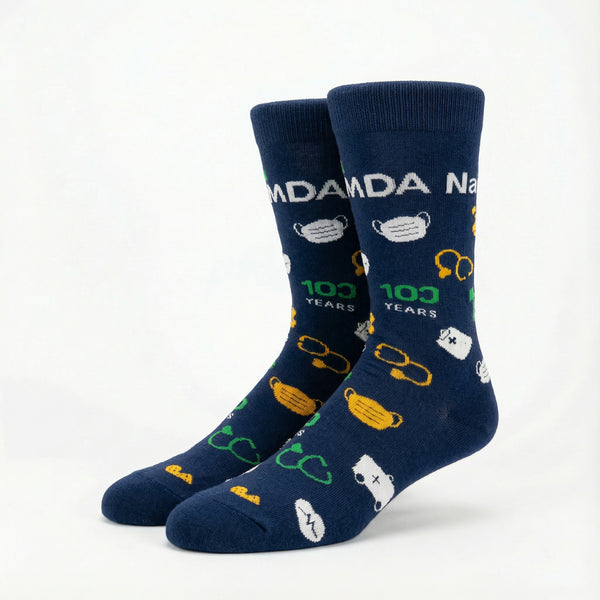
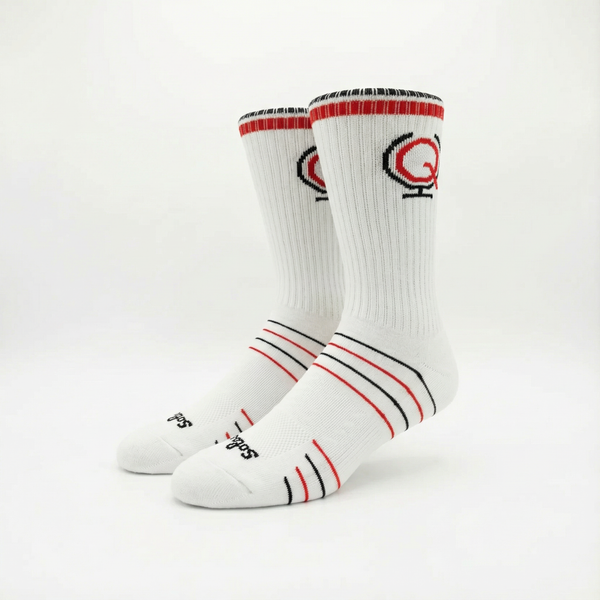
The most widely produced and most commonly custom-branded length, sitting roughly mid-calf. Crew is the default choice across corporate gifting, general athletic wear, and casual branded merchandise because it balances visibility (enough surface area for a logo or design) with everyday comfort and versatility across most footwear styles.
Mid-Calf / Extended Crew
Sits slightly higher than a standard crew, closer to two-thirds up the calf. Used where a slightly taller profile is wanted without going fully over-the-calf — common in some workwear and outdoor applications.
Knee-High / Over-the-Calf (OTC)
Extends to just below the knee. This is the standard length for sports requiring coverage over shin guards or tall boots — football, soccer, and equestrian riding all typically call for this length, since it needs to stay in place under equipment rather than just look tall.
Thigh-High
Extends above the knee toward the thigh, held up independently or with a garter. Rare outside specific fashion, medical compression, or historical/uniform contexts — not a length used in general branded or corporate sock programs.
The Sock Length Comparison Chart
| Length | Where It Sits | Typical Use |
|---|---|---|
| No-show / liner | Below the ankle bone | Hidden wear with low-cut shoes; not suited to branding |
| Ankle / quarter | At or just above the ankle | Casual and athletic everyday wear |
| Crew | Mid-calf | Corporate gifting, general athletic and casual branded wear |
| Mid-calf / extended crew | Two-thirds up the calf | Workwear, some outdoor applications |
| Knee-high / over-the-calf | Just below the knee | Football, soccer, equestrian — anything worn over shin guards or tall boots |
| Thigh-high | Above the knee, toward the thigh | Fashion, medical compression, uniform contexts |
Crew vs. Quarter Socks: The Most Confused Pair
Crew and quarter socks get mixed up constantly in casual conversation because the size difference, while consistent, isn't dramatic at a glance. The real distinction is functional as much as visual:
| Crew | Quarter | |
|---|---|---|
| Height | Mid-calf | At or just above the ankle |
| Branding surface area | More room for a logo, pattern, or design | Limited — usually just enough for a small logo |
| Best for | Corporate gifting, team kit, general branded merch | Low-cut athletic shoes, casual everyday wear where a low profile matters |
For anything involving custom branding specifically, crew is almost always the more practical choice — the additional surface area matters more for logo visibility and design complexity than the marginal difference in warmth or coverage.
A Simple Way to Decide Between Them for Everyday Wear
Outside of branding considerations, the practical choice between crew and quarter usually comes down to shoe style and personal preference rather than any strict rule. Quarter socks pair naturally with low-cut sneakers and casual trainers, where a taller crew sock can bunch or show above the shoe line in a way that looks unintentional. Crew socks pair better with boots, dress shoes, and any footwear with a higher ankle cut, where a quarter sock would leave a visible gap of bare leg. Neither is objectively better — the shoe you're pairing it with usually settles the question.
Sock Styles by Purpose, Not Just Length
Length is one axis; purpose-built style is another, and the two combine rather than substitute for each other:
- Dress socks — typically crew length, finer knit, worn with formal or business footwear
- Casual socks — crew or quarter length, everyday comfort-focused construction; our guide to custom casual socks covers this category in more depth
- Athletic/sport socks — length varies by sport, but typically includes reinforced heel and toe, arch support, and moisture-wicking material; covered across our custom sport socks for team uniforms guide
- Compression socks — graduated compression construction, length varies from ankle to knee-high depending on the intended use
- Workwear socks — often heavier, thicker construction regardless of length, built for durability over comfort refinement
Length and Style Work Together, Not Separately
It's worth remembering that length describes where the sock ends, while style describes what the sock is built to do — the two combine rather than compete. A crew-length athletic sock and a crew-length dress sock share a length but almost nothing else in construction: different knit density, different reinforcement, different material weighting toward moisture management versus refined appearance. When researching "types of socks," it's easy to conflate the two axes and end up comparing a length category against a purpose category as if they were the same kind of choice. Settling on length first, then purpose-built style within that length, tends to produce a clearer decision than trying to solve both at once.
Types of Socks: UK Terminology Differences
Sock terminology is largely consistent between the US, UK, and Australia, but a few naming differences are worth knowing if you're sourcing or gifting across markets:
- "Trainer socks" is common UK terminology for what US buyers typically call no-show or liner socks
- "Football socks" in UK usage specifically means the knee-high, over-the-calf style worn with shin guards — the same construction US buyers might call a soccer sock
- "Dress socks" and "crew socks" are used consistently across all three markets with the same meaning
If you're building a sock program spanning multiple English-speaking markets, it's worth confirming terminology explicitly with your supplier rather than assuming a term means exactly the same construction everywhere — a small naming mismatch can lead to the wrong length arriving for an event or team order.
Choosing the Right Length and Style for Your Use Case
- Corporate gifting or general branding — crew length, dress or casual style, for the best balance of logo visibility and everyday wearability
- Sports requiring shin guards or tall boots — knee-high/over-the-calf, confirmed against your specific sport's equipment requirements
- General athletic or gym use — crew or quarter length athletic construction, depending on shoe style and personal preference
- Workwear or industrial use — length matched to safety requirements, typically crew or taller, in a heavier-weight construction
Our complete custom socks buyer's guide covers the rest of the decision — material, branding method, MOQ, and pricing — once you've settled on the right length and style for your program.
Frequently Asked Questions
What's the difference between crew and quarter socks?
Crew socks sit mid-calf, while quarter socks sit at or just above the ankle. Crew offers more surface area for branding and is the more common choice for custom and corporate sock programs; quarter suits a lower-profile look with athletic shoes.
What sock length is used for football and soccer?
Knee-high, over-the-calf length — this covers the shin guard fully and is the standard expected length for competitive football and soccer at nearly all levels.
Are sock length names the same in the US, UK, and Australia?
Mostly, yes — crew and dress socks mean the same thing across all three markets. A few terms differ: UK "trainer socks" corresponds to US "no-show" or "liner" socks, and UK "football socks" specifically means the over-the-calf style.
What length sock is best for custom branding?
Crew is generally the best default for custom branding — it offers enough surface area for a logo or design while suiting the widest range of footwear and use cases, from corporate gifting to general team wear.
How do I design my own custom socks once I know the length I need?
Once you've confirmed length and style, the next step is choosing material, branding method, and quantity — you can design your own custom socks directly, or start with our complete buyer's guide if you want the full decision framework first.
Does sock length affect price?
Generally yes, though modestly — a taller sock (knee-high or over-the-calf) uses more material than a crew or quarter sock, which can add a small amount to the per-unit cost. The bigger price drivers are typically branding method and material choice rather than length alone.
What length sock should I choose for a corporate gifting program?
Crew is the standard recommendation for corporate gifting — it offers enough surface area for a logo or design to read clearly, works with the widest range of footwear a recipient might already own, and avoids the more sport-specific fit considerations that come with a knee-high or over-the-calf length.
Ready to design your own custom socks?
Free artwork mockup within 12 hours — choose your length, material, and branding method with our team.
Design Your Socks →