
Personalised socks can mean a company logo for staff and events, names and numbers for a team, a logo on performance socks, or initials for a gift. This guide explains each kind of order, the choices you'll make, and what to check before you order.
Four kinds of personalised sock orders
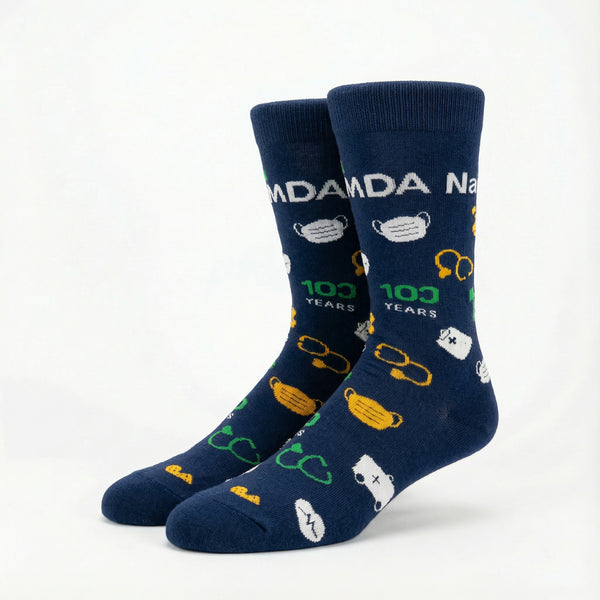
- Corporate and B2B branding — your logo on socks for staff, events or client gifts. This buyer wants consistent branding, bulk pricing, and a fast turnaround for an event or onboarding kit.
- Team and club personalisation — matching team socks with each player's name or number. This buyer needs matching designs with individual name or number variation across a roster.
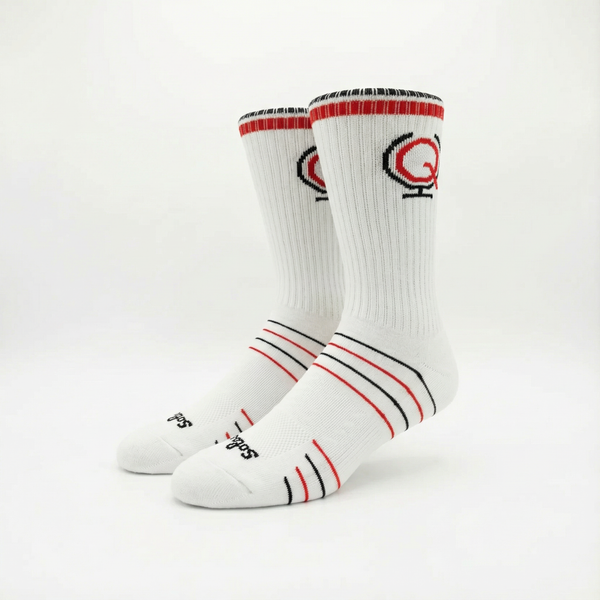
- Technical/performance personalisation — athletic, equestrian or cycling socks carrying your logo. This buyer cares about fit and material first, branding second.
- Individual gifting personalisation — socks with someone's initials or name. Smaller orders, and often the first step before a larger team or company order.
Knit-in or printed?
Knit-in means the logo or name is part of the fabric, so it doesn't fade. Printing (sublimation) allows full-colour designs and a different name or number on every pair. For team names and numbers, printing is usually the practical choice; for a company logo, knit-in lasts longer.
Personalised or personalized?
Same product. UK, Australian and New Zealand buyers spell it with an "s", US buyers with a "z".
Personalised Socks for Corporate and B2B Buyers
This is the highest-value segment searching this term, and the one most underserved by generic "personalised socks" content that's written for gift shoppers. Our honest buyer's breakdown of the custom sock market covers the supplier-evaluation side of this in more depth.
What this buyer actually needs to know:
- Minimum order quantity. The Solos minimum is 60 pairs per design, so small teams and single departments can order, not only large companies.
- Artwork turnaround. A same-day free artwork proof matters more to this buyer than almost anything else — they're usually working against an event date.
- Certifications. Corporate buyers sourcing on behalf of a company increasingly need to answer for supply chain ethics — look for OEKO-TEX® Standard 100 certified yarns and BSCI-rated factories, visible rather than buried in fine print.
- Reorder consistency. A logo that renders slightly differently on a reorder months later is a real, recurring complaint in this category — ask any supplier how they maintain colour and placement consistency across production runs, ideally via a Pantone (PMS) colour-matching system.
The process itself is usually simplest when it follows a clear three-step flow: share brand guidelines, review a design mockup, then receive the finished order.
Budgeting note: personalisation setup (preparing the design file and production programming) is typically separate from the per-pair unit cost. A supplier that folds setup into a single flat quote without breaking it out makes it harder to compare true reorder cost against a first order — and reorders, not first orders, are where corporate programs actually save money.
Personalised Socks for Teams and Clubs
Team buyers search differently — usually "custom team socks," "personalised socks for [sport]," or "team socks with names and numbers." The intent signal here is roster-level variation: the same base design needs individual name, number, or initial swapped in per pair.
- Getting consistent colour matching across a full roster order, not just a single sample
- Managing individual variation (names, numbers) without re-running the whole production process per person
- Timing the order around a season start, which is also when supplier lead times stretch the most
Sport-specific constructions matter here too. A custom cycling sock and a custom equestrian sock are built on different base fits, even when the personalisation process (logo, colours, team name) looks identical from the buyer's side.
Personalised Socks for Technical and Performance Buyers
This intent overlaps with corporate and team searches but is driven by a different priority entirely: fit and function first, branding second. Buyers here are searching things like "custom workwear socks with logo" or "personalised equestrian socks" — and they'll reject a supplier immediately if the technical spec is vague, no matter how good the personalisation options look.
What actually matters to this buyer:
- Material and construction — bamboo, organic cotton, or technical blends, matched to the actual use case (office wear vs. bamboo outdoor workwear or cotton workwear vs. sport-specific)
- Fit consistency — Solos' own size guide notes that one-size-fits-most (OSFM) sizing is used in over 96% of orders specifically to keep fit and pricing consistent across a bulk run
- Wash durability — how personalisation holds up over repeated washing, a real concern for uniform and workwear programs
- Care requirements — cold wash, gentle cycle, air dry — the kind of detail that belongs on a product page, not buried in a shipping policy
Content written for this buyer needs the technical spec to lead, with personalisation options presented as a configuration choice layered on top — not the other way around.
Frequently Asked Questions
What's the minimum order for personalised socks?
The Solos minimum is 60 pairs per design. Larger orders get a lower price per pair.
How long does personalisation take to produce?
Free artwork proofs typically turn around within 12 hours. Standard production runs 3–4 weeks after artwork approval, with an Express Production option available at 7–21 days for urgent orders. Delivery after dispatch is generally 4–6 business days within Australia and 2–5 business days to the US, UK, NZ, and Europe via DHL Express or FedEx Express.
Can a logo be personalised accurately across a full order?
Yes, but simple shapes and bold colour blocks reproduce more reliably than fine detail or gradients. Jacquard knit-in branding (weaving the logo directly into the fabric) holds up permanently, while printed branding can crack or fade over time. Ask whether your supplier uses a Pantone (PMS) matching system — this is the detail that actually determines colour consistency across a production run.
Do personalised socks need to match exactly across a large order?
They should. Ask any supplier directly how they maintain colour and placement consistency across a full production batch — this is the single most common quality complaint in bulk personalisation orders.
Is "personalised" or "personalized" the correct spelling to search?
Both are correct — "personalised" is standard in UK, Australian, and Canadian English, while "personalized" is standard in US English. Search engines generally treat them as the same intent, but it's worth using both spellings in your own content if you're targeting multiple English-speaking markets.
What's the difference between personalised socks and custom socks?
In practice, the terms overlap heavily, but "personalised" more often implies individual-level variation (a specific name, initial, or number), while "custom" more often implies a single design applied consistently across a batch, such as a company logo. Confirm which one you actually need when you enquire, since it can affect production method and pricing.
Ready to personalise your own order?
Free artwork mockup within 12 hours — no paid samples, no deposits, no lock-in until you approve the design.
Request Free Mockup →
