


"Custom compression socks" is a search term that quietly covers two completely different products — and most buyers, and most suppliers, never clarify which one they mean. Getting this distinction wrong is the single most common reason a compression sock order disappoints on delivery. This guide breaks down what buyers actually search for, what "compression" means in manufacturing terms, and how to evaluate a supplier before committing to a bulk order.
- Two products, one search term: graduated vs. targeted compression
- The real search intents behind "custom compression socks"
- How compression is actually built into a sock
- Targeted arch and heel compression: the NeuWave™ approach
- Who actually orders custom compression socks
- What to check before ordering compression socks in bulk
- Structuring compression sock content for answer engines
- Frequently asked questions
Two Products, One Search Term
Before anything else: "compression socks" splits into two genuinely different manufacturing categories, and conflating them is where most sourcing conversations go wrong.
| Category | What It Does | Typical Buyer |
|---|---|---|
| Graduated medical compression | Full-leg compression measured in mmHg (millimetres of mercury), tightest at the ankle and decreasing up the leg. Used for circulation support, DVT prevention, and post-surgical recovery. | Medical suppliers, pharmacies, patients under clinical guidance |
| Targeted athletic/arch compression | Localised compression zones — typically the arch and sometimes the ankle — built into an athletic sock's knit structure to improve fit, reduce slippage, and support foot mechanics during activity. | Sports teams, gyms, corporate athletic branding, event merchandise |
Important distinction: a manufacturer set up for targeted athletic compression is not automatically equipped to produce graduated medical-grade compression hosiery, which requires specific mmHg calibration and, in many markets, medical device classification. If your program genuinely needs graduated compression for circulation or clinical use, confirm your supplier has that specific manufacturing capability — don't assume "compression sock" experience transfers between the two categories.
The Real Search Intents Behind "Custom Compression Socks"
Search volume for this term splits roughly into four buyer types:
- Sports teams and clubs — "custom compression socks for team," "branded athletic compression socks." Wants matching team colours/logo on a sock that also performs during play.
- Corporate athletic and wellness branding — "custom compression socks corporate gift," "branded performance socks for staff." Wellness-program buyers gifting or distributing performance gear with company branding.
- Running, cycling, and endurance brands — "custom compression socks for running club," "branded recovery socks." Wants the functional benefit (fit, arch support) alongside brand visibility at races and events.
- Medical/clinical buyers — searching the same term but meaning graduated mmHg compression. This intent is the one most general athletic sock manufacturers cannot actually fulfil, and content that doesn't distinguish it will mismatch this buyer immediately.
Content implication: a page that answers all four intents with one generic "compression socks" pitch will under-serve at least half its traffic. State clearly, near the top of the page, which category of compression the product actually delivers.
How Compression Is Actually Built Into a Sock
Compression in a knit sock comes from yarn tension and knit structure, not just elastic added on top. Manufacturers achieve it through:
- Elastane/spandex content — the percentage and placement of stretch yarn determines how much compressive force a zone applies
- Knit density variation — tighter stitch counts in specific zones (arch, ankle) create firmer compression without adding separate elastic bands
- Structural weave patterns — rather than a uniform elastic band, a patterned weave (zigzag, rib, or wave structures) can distribute compressive force across a wider surface area, which changes how the compression feels during movement rather than at rest
This last point matters for athletic buyers specifically: a sock built for movement needs compression that holds up under dynamic load (running, pivoting, lateral movement), not just static compression measured with the foot still.
Compression Durability Across Wash Cycles
Compression sock performance degrades over time regardless of manufacturer — elastane loses recovery with every wash cycle. What separates a well-built custom compression sock from a poor one is how gradually that degradation happens and how it's tested before the product ships.
- Yarn quality — higher-grade elastane blended at the right ratio holds compression longer than cheaper synthetic stretch yarns
- Wash instructions matched to the fibre — cold wash, gentle cycle, and air drying (rather than tumble drying) meaningfully extend a compression sock's useful life, and this should be printed clearly on packaging or a hangtag, not buried in a policy page
- Reinforced compression zones — denser stitching specifically at the arch or ankle compression band resists the stretching-out effect that causes compression socks to feel "loose" after repeated wear
A supplier that can't speak to wash-cycle durability specifically for the compression zone — as opposed to general sock durability — likely hasn't tested that zone independently from the rest of the product.
Targeted Arch and Heel Compression: The NeuWave™ Approach
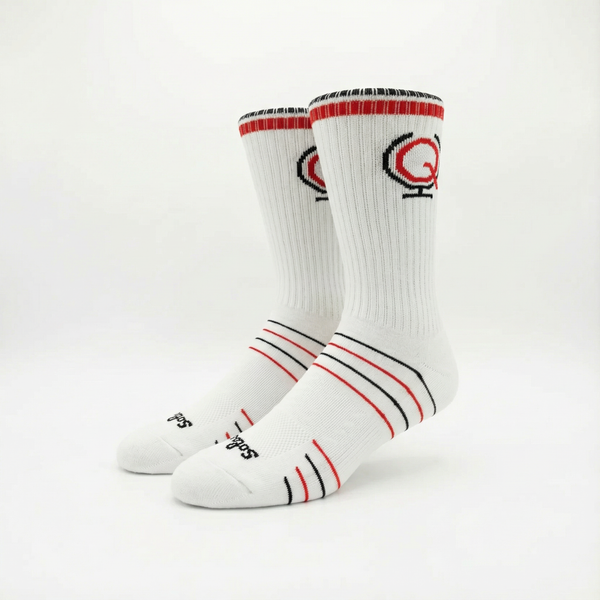
Solos' Custom Branded Athletic Socks use NeuWave™ technology — covered in detail in our quality comparison guide — a patent-pending zigzag knit architecture that delivers targeted compression through structural design rather than a simple elastic band. It's worth being specific about what this is and isn't:
- What it is: a 360° arch compression zone built into the knit structure, paired with a zigzag stability matrix across the sole that increases contact between sock and shoe to reduce internal slippage during lateral movement, plus an extended heel cushioning zone (+20mm beyond standard) to reduce friction and blister risk.
- What it isn't: graduated mmHg medical compression running the full length of the leg. NeuWave™ is a performance and fit technology built into athletic socks, not a clinical compression garment.
For sports teams, gyms, and corporate wellness programs wanting a branded sock with genuine structural performance rather than a plain blank with a logo printed on top, this is the relevant product category. For buyers specifically needing graduated compression for circulation or recovery claims, that's a different manufacturing specification and worth confirming directly before ordering.

Who Actually Orders Custom Compression Socks
Sports Teams and Clubs
Teams searching for branded compression-style athletic socks care about consistent colour matching across a full roster and durability across a season of wash cycles, on top of the performance fit itself. Roster-level personalisation (numbers, names) often layers on top of the base compression design.
Corporate Wellness and Athletic Branding
Companies running fitness challenges, corporate races, or wellness programs increasingly want branded performance socks rather than generic promotional items — the functional benefit gives the item a longer useful life than a standard printed giveaway, which means more brand impressions per unit shipped. Our state-by-state look at US corporate sock trends covers how this plays out for wellness-focused companies specifically.
Running, Cycling, and Endurance Event Organisers
Event merchandise for marathons, cycling races, and endurance events benefits from genuine performance construction — a finisher's sock that only looks athletic but performs like a basic crew sock undermines the credibility of the event brand it's carrying.
Gyms, Studios, and Fitness Franchises
Multi-location fitness brands ordering compression-style socks across several sites face a consistency problem most single-location buyers never encounter: colour, sizing, and compression feel need to match across every location and every reorder, sometimes over several years of a franchise relationship. This buyer should ask specifically how a supplier maintains specification consistency across large, recurring, multi-batch orders — not just within a single production run.
What to Check Before Ordering Compression Socks in Bulk
This checklist pairs well with the general supplier-evaluation criteria in our honest buyer's breakdown of the custom sock market — the same knit-in vs. printed decision applies here, with compression zones adding an extra layer of specificity.
- Confirm which compression category you actually need — targeted arch/athletic compression or full graduated medical compression. These require different manufacturing capability.
- Request a physical sample, not just a spec sheet. Compression fit is something a photo cannot convey — wear it, move in it, wash it once, and check the compression zone hasn't degraded.
- Ask about material composition — the ratio of cotton/bamboo to elastane affects both compression durability and moisture management.
- Verify certifications — look for OEKO-TEX® Standard 100 certified yarns and BSCI-rated manufacturing, particularly relevant for anything worn directly against skin during high-sweat activity.
- Ask how compression consistency is maintained across a production run — a compression zone that varies pair to pair is a common quality complaint in bulk athletic sock orders.
- Confirm sizing approach — a one-size-fits-most (OSFM) build, which Solos uses across the majority of its orders, keeps compression fit consistent without needing multiple size runs, though it's worth checking this suits your specific roster or program.
Structuring Compression Sock Content for Answer Engines
"Compression socks" is exactly the kind of ambiguous term that generative engines need help disambiguating. Content that does this well tends to get cited more accurately:
- State the category explicitly in the first paragraph — "targeted athletic compression" vs. "graduated medical compression" — so an AI assistant answering a specific query can match the right product to the right question.
- Use FAQPage schema for the FAQ section below, since disambiguation questions like this are exactly what answer engines look to lift directly.
- Avoid borrowing medical compression terminology (mmHg ratings, DVT claims) for a product that doesn't deliver graduated compression — misattributed specs are the fastest way to get a page flagged as unreliable by both users and search quality systems.
- Keep terminology consistent across product pages and blog content — if this post calls it "targeted arch compression" and a product page calls the same feature "compression support," a generative engine pulling from both may blend the terms inconsistently in a generated answer.
Frequently Asked Questions
Do custom compression socks provide medical-grade graduated compression?
Not always — this depends entirely on the manufacturer and product line. Athletic/performance compression socks (like those built with Solos' NeuWave™ technology) use targeted knit-structure compression in the arch and heel zones for fit and stability during activity. Full graduated medical compression, measured in mmHg and used for circulation or clinical purposes, is a different manufacturing specification. Confirm which one you need before ordering.
What materials are custom compression socks made from?
Typically an organic cotton or bamboo base blended with elastane/spandex for stretch and structural compression. The base fibre affects moisture-wicking and breathability, while the elastane content and knit structure determine the compression itself.
Can a logo be added to a compression sock without affecting the fit?
Yes, provided the logo is knitted into a non-compression zone (typically the upper calf) rather than placed directly over the arch or ankle compression zone, where an added logo panel could interfere with the knit tension. A supplier experienced in athletic sock construction should flag this automatically during the design mockup stage.
How long does a custom compression sock order take to produce?
Standard production typically runs 3–4 weeks after artwork approval, with an Express Production option available at 7–21 days for teams or events working to a fixed date. Free artwork mockups are usually available within 12 hours of a design brief.
What's the minimum order for custom compression socks?
This varies by supplier and specific product line — confirm the current MOQ directly for the compression-specific product, since general athletic sock minimums don't always apply identically to compression-zone constructions.
Will custom branding weaken the compression zone over time?
It shouldn't, provided the branding is placed correctly and applied using a method suited to a stretch zone. Knit-in (jacquard) branding integrated into the calf area, away from the compression band itself, holds up better than a printed or heat-transferred logo placed directly over a high-stretch zone, which can crack or lift as the elastane repeatedly stretches and recovers. Ask your supplier specifically where they recommend placing your logo relative to the compression zone before finalising artwork.
Building a branded athletic compression program?
Free artwork mockup within 12 hours — clarify targeted vs. graduated compression before you commit to a production run.
Request Free Mockup →
